

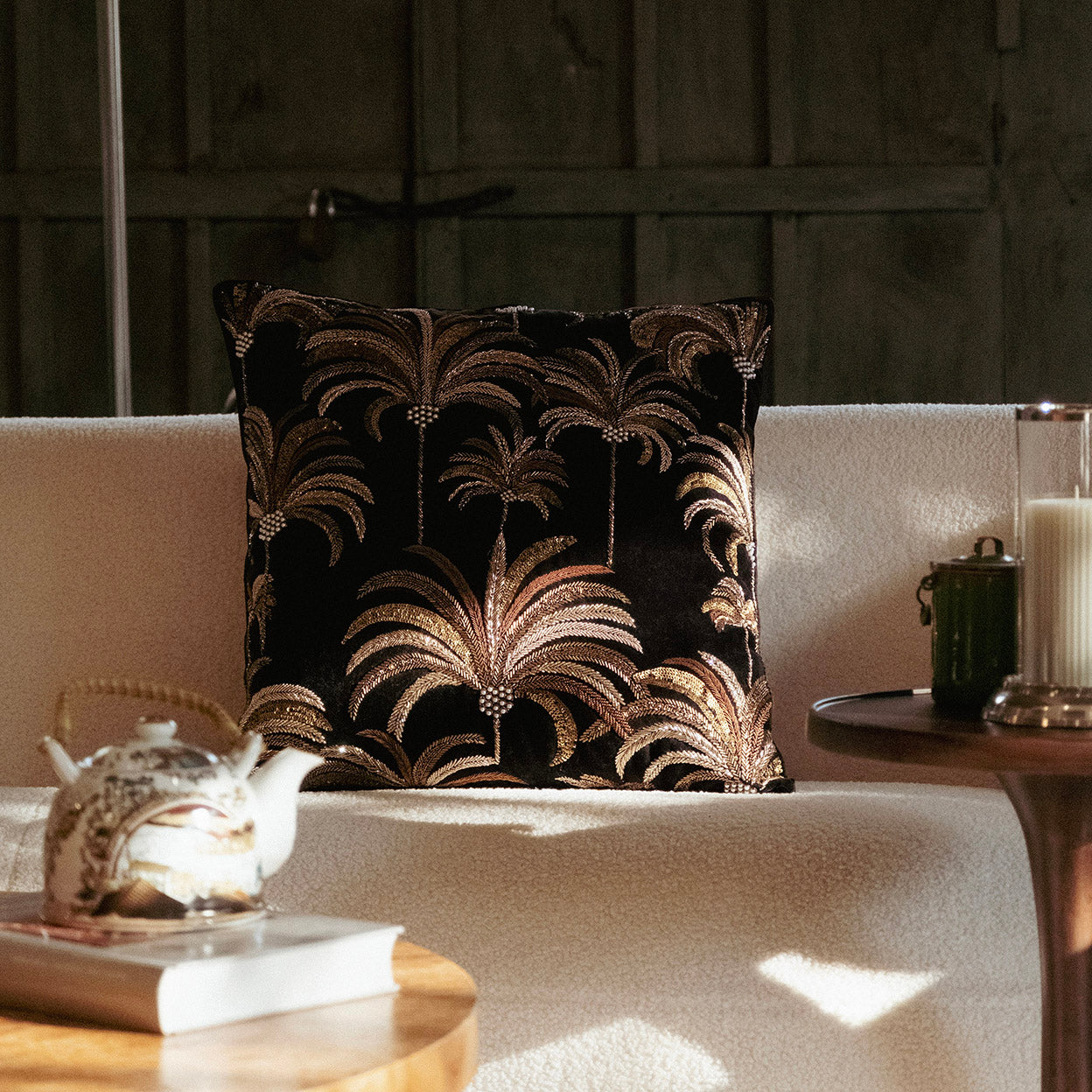
Palm as Vertical Rhythm
Study Intent
This study examines the palm motif as a vertical structural rhythm.
The surface investigates how density, material weight, and calibrated metallic interruptions can establish hierarchy without repetition. Rather than dispersing pattern across the field, the motif is held with intention — allowing richness to emerge from material logic rather than visual excess.
Opulence here is controlled. The objective is to understand how embroidered surfaces may carry ceremonial gravity while remaining architecturally restrained.
Spatial Behaviour & Resonance
The surface functions as an anchor.
It absorbs light, holds shadow, and stabilises surrounding elements through depth rather than contrast. Metallic articulation is introduced sparingly, not to shimmer, but to punctuate weight.
The study suits interiors that rely on proportion, contrast, and material confidence. It resonates with spatial compositions where cultural memory is embedded quietly rather than performed visibly.
Process & Material Calibration
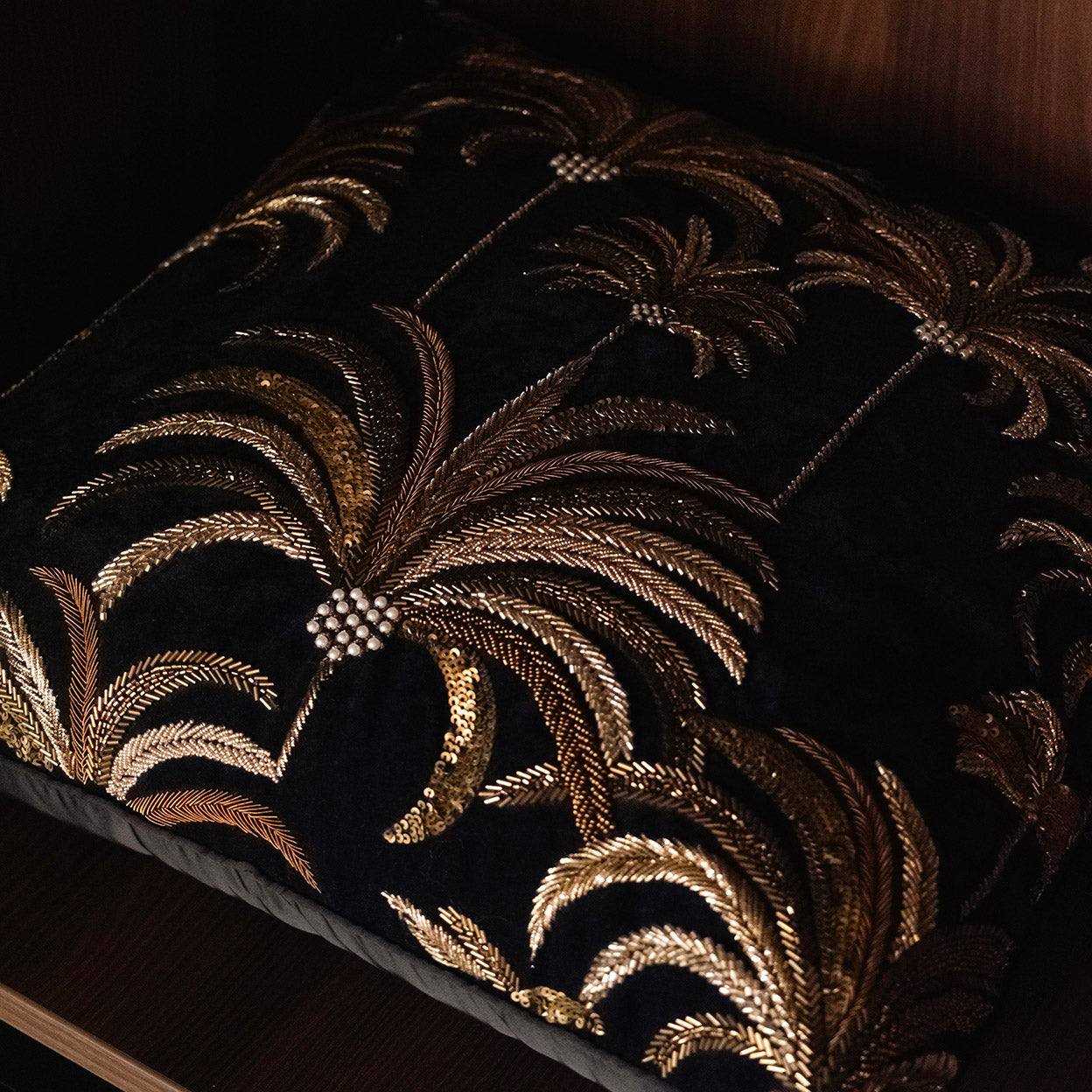
The palm form was first articulated at cushion scale to evaluate proportion, stitch density, and metallic balance.
Multi-material embroidery was layered across a performance velvet substrate to test how weight accumulates across the field. Particular attention was given to controlling metallic interruption, ensuring it reinforces hierarchy rather than dispersing attention.
This study required approximately 120 hours of surface development and hand embellishment. Here, craft operates as structural calibration.
Current Manifestation
Initially developed as a soft furnishing surface application to test scale, density, and edge articulation.
Substrate: Performance Poly Velvet
Medium: Hand embroidery with multi-material articulation
Expansion & Commissioning Potential
This surface logic may extend across planes where verticality and material weight are required:
• Architectural wall panels / Framed textile compositions
• Upholstered headboards
• Integrated textile wall systems
Commissioning allows recalibration of density, metallic emphasis, and negative space — adapting the hierarchy of the motif to specific spatial intent rather than replicating form.
To understand how such investigations evolve into larger systems, explore Surface Systems.
For bespoke applications, see Working Together.
Surface Study Details
Medium: Hand embroidery with multi-material articulation
Substrate: Textile base (Performance Poly Velvet)
Scale: Cushion-scale study (expandable to architectural panel format)
Hours of Devotion: ~120 hours
Architectural Potential: Wall panels, framed textile compositions, commissioned surface systems
Optionen auswählen
Commissioned Adaptations
While initially developed at an intimate scale, each surface study holds potential for architectural recalibration. Density, motif structure, and material articulation can be restructured in response to wall dimensions, spatial rhythm, and site context. Commissioned adaptations evolve through the studio’s structured development framework.