The Technical Guide to Embroidered Veneer Panels - When Wood and Thread Operate as One Surface
Introduction
Embroidered veneer panels are not decorative overlays.
They are architectural surface systems where timber and thread operate as a single constructed plane.

Often referred to as stitched veneer or veneer embroidery, this material approach integrates calibrated thread articulation directly within timber veneer before final panel construction. The result is not textile applied onto wood, but wood structurally reorganised through thread.
As designers increasingly search for new surface materials and innovative wall panel options, embroidered veneer panels offer a materially grounded yet visually dimensional alternative to printed or laminated finishes.
This guide explains how embroidered veneer panels are constructed, how they behave spatially, and how they integrate into contemporary interiors.
What Is an Embroidered Veneer Panel?
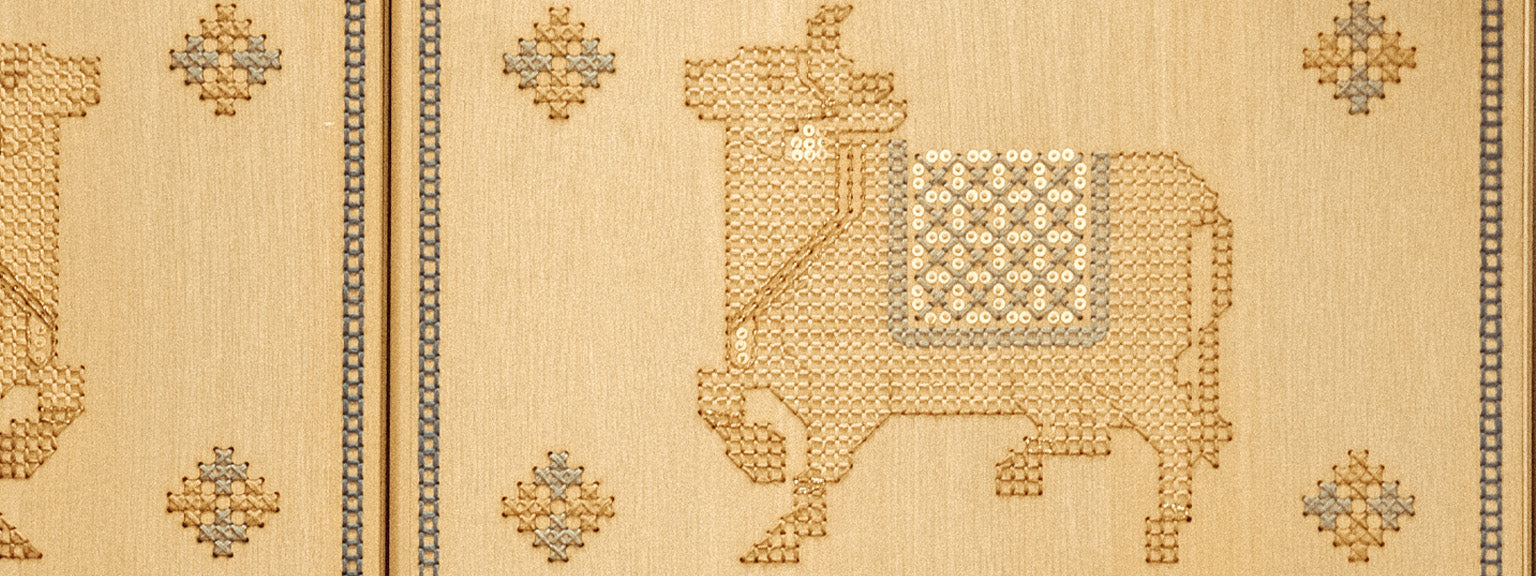
An embroidered veneer panel is a timber veneer surface that has been structurally perforated and articulated with hand embroidery.
Unlike applied textile panels, the thread becomes part of the veneer layer itself before stabilisation onto a calibrated substrate.
This process transforms veneer from a flat decorative finish into a dimensional architectural surface.
The embroidery does not sit on the surface.
It reorganises it.
Stitched Veneer vs Embroidered Veneer
The terms stitched veneer and embroidered veneer are often used interchangeably.
Both describe the integration of thread within timber veneer surfaces. The distinction lies less in terminology and more in construction logic — where stitch density, perforation calibration, substrate stability, and panel engineering determine performance and longevity.
In architectural application, structure precedes ornament.
Grain Direction & Structural Awareness
Veneer grain determines needle entry direction, stitch alignment, and tension behaviour.
The thread must move with the timber grain, not against it.
Ignoring this relationship can lead to cracking, warping, or surface stress over time. When calibrated correctly, embroidery enhances timber rhythm rather than disrupting it.
Substrate & Backing Logic
Veneer alone is delicate. Embroidered veneer panels require:
• Calibrated architectural backing (plywood or MDF)
• Balanced panel construction
• Controlled humidity awareness
• Edge reinforcement
Embroidery introduces tension.
Panel engineering stabilises it.
This balance allows embroidered veneer wall panels to function reliably as custom veneer wall cladding or integrated joinery surfaces.
Density & Relief Calibration
Thread density determines how the panel behaves in space.
• High-density French knots create tactile relief fields
• Linear stitches create incision-like rhythm
• Metallic articulation modifies reflectivity
• Negative space stabilises composition
Density is not an aesthetic choice alone — it is spatial calibration.
A panel viewed from 6 metres behaves differently from one viewed at arm’s length.
Architectural Integration
Before fabrication begins, the following must be resolved:
• Wall dimensions and panel segmentation
• Viewing distance
• Light direction and shadow fall
• Adjacency to stone, plaster, or metal
• Joinery alignment
• Installation method (flush, inset, shutter-based, framed)
Embroidered veneer panels must align with architectural rhythm — not compete with it.
Layered Construction Logic

Embroidery integrates within the veneer before final stabilisation, ensuring the surface reads as a coherent architectural system rather than applied decoration.
Case Reference: Lift Interior (Private Commission)
In a residential lift interior, embroidered veneer panels were integrated within a confined architectural envelope.
The proximity required calibrated density — enough relief to register at arm’s length, yet restrained to avoid visual compression.
Here, stitched veneer operated as environmental modulation. Timber absorbed light while thread introduced subtle shadow variation during ascent and descent.
Case Reference: Shiraz — Carpet as Architecture
In the Shiraz surface study, Persian carpet logic was translated into embroidered veneer wardrobe shutters.
Rather than replicating a textile pattern, the thread entered veneer as structural rhythm. The shutters function as continuous architectural planes rather than decorative inserts.
Embroidery reorganised the timber surface, allowing cultural memory to embed within joinery.
Scaled Fragments: Edition 01 — Architectural Collectables
The same embroidered veneer logic extends into smaller architectural objects.
In Edition 01, calibrated French knot density translates into:
• Veneer trays
• Storage boxes
• Photo frames
• Framed surface compositions
Though object-scale, they retain architectural surface discipline.
Objects are not separate from the system.
They are fragments of it.
Are Embroidered Veneer Panels a New Surface Material?
As interior architecture evolves, designers increasingly seek innovative wall panel materials that combine craft with structural clarity.
Embroidered or stitched veneer panels represent a contemporary surface approach — merging timber, thread, and calibrated relief into a unified architectural plane.
Unlike printed veneer or synthetic laminates, veneer embroidery introduces dimensional shadow, tactile depth, and material authenticity while remaining compatible with joinery systems.
For projects exploring bespoke veneer panels or contemporary surface finishes, this material system offers both performance and presence.
Longevity & Performance
A properly constructed embroidered veneer panel:
• Maintains structural stability
• Ages with timber patina
• Preserves stitch integrity
• Does not peel or delaminate
Performance depends on:
• Material calibration
• Backing stability
• Environmental awareness
• Installation alignment
Embroidery is executed with timber expansion and contraction in mind.
Commissioning Embroidered Veneer Panels
Development typically includes:
-
Spatial evaluation
-
Material sampling
-
Density calibration
-
Panel engineering
-
Installation coordination
Each project is developed from scratch.
There is no inventory model.
Scale, density, and articulation are always site-specific.
Closing
When embroidery operates within veneer, timber changes how it holds space.
Light softens.
Relief deepens.
Narrative embeds into joinery.
This is not decorative veneer.
It is architectural surface construction through thread.
For commissioned embroidered veneer panels and custom-stitched veneer systems, consultation begins with spatial evaluation.