

Fern as Vertical Canopy
Study Intent
This study examines how embroidery can reinforce architectural surface without introducing ornament.
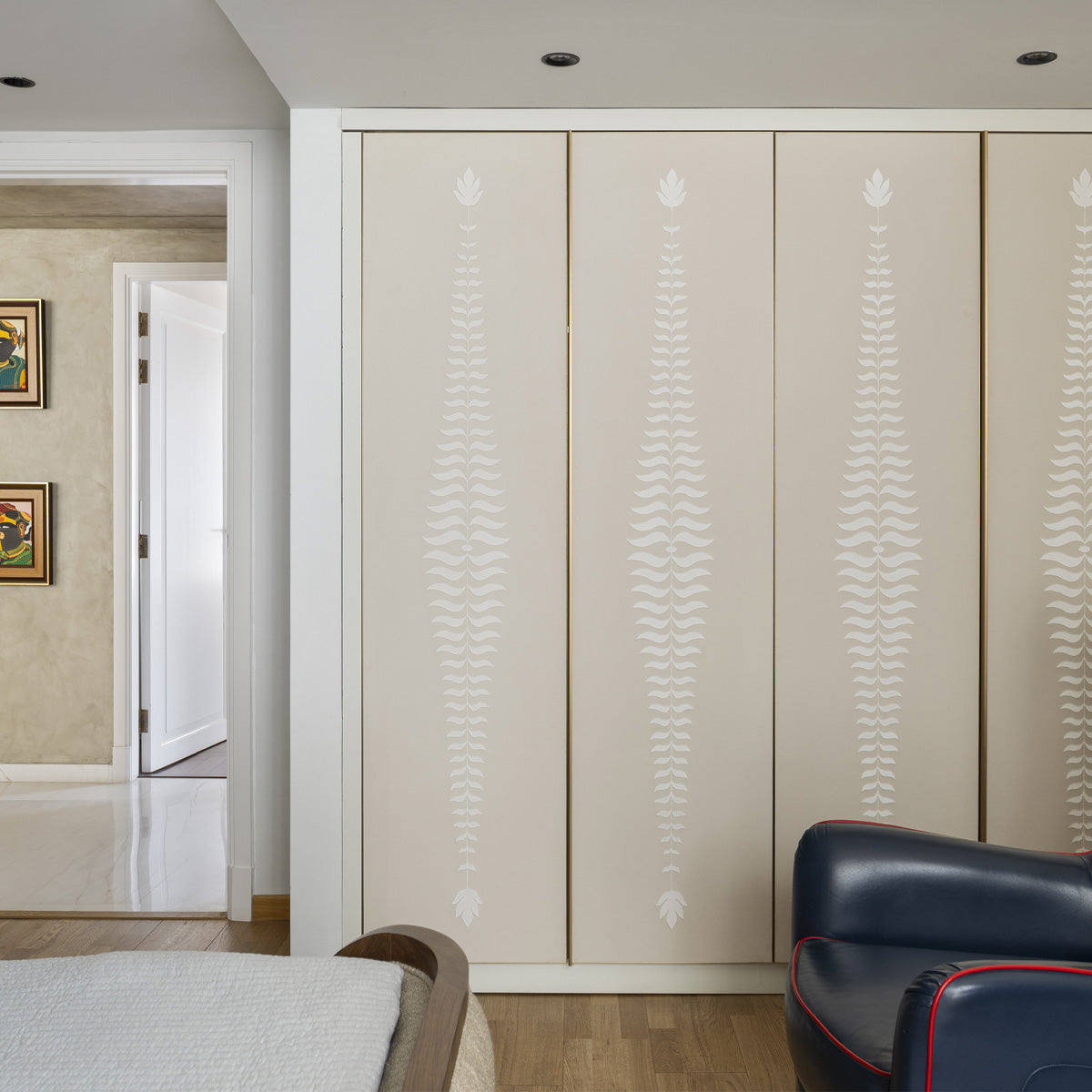
The fern motif was first developed at a small scale as a prototype — testing proportion, stitch density, and paper compatibility. Once resolved, the study was scaled vertically to operate across full-height wardrobe shutters.
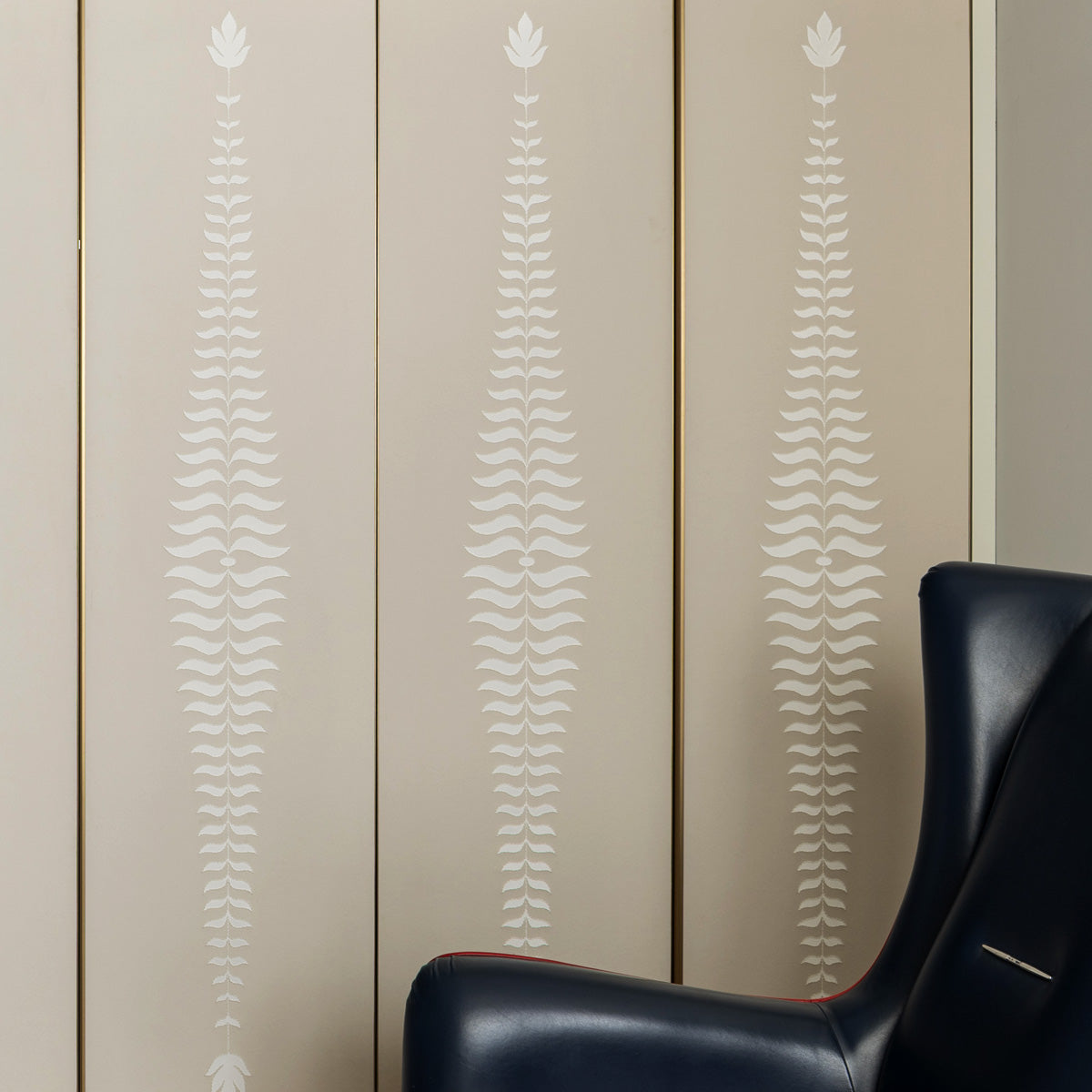
Rather than repeating a pattern across the field, a single bi-directional fern axis was introduced per shutter. The gesture is measured and architectural, rising and descending in continuity.
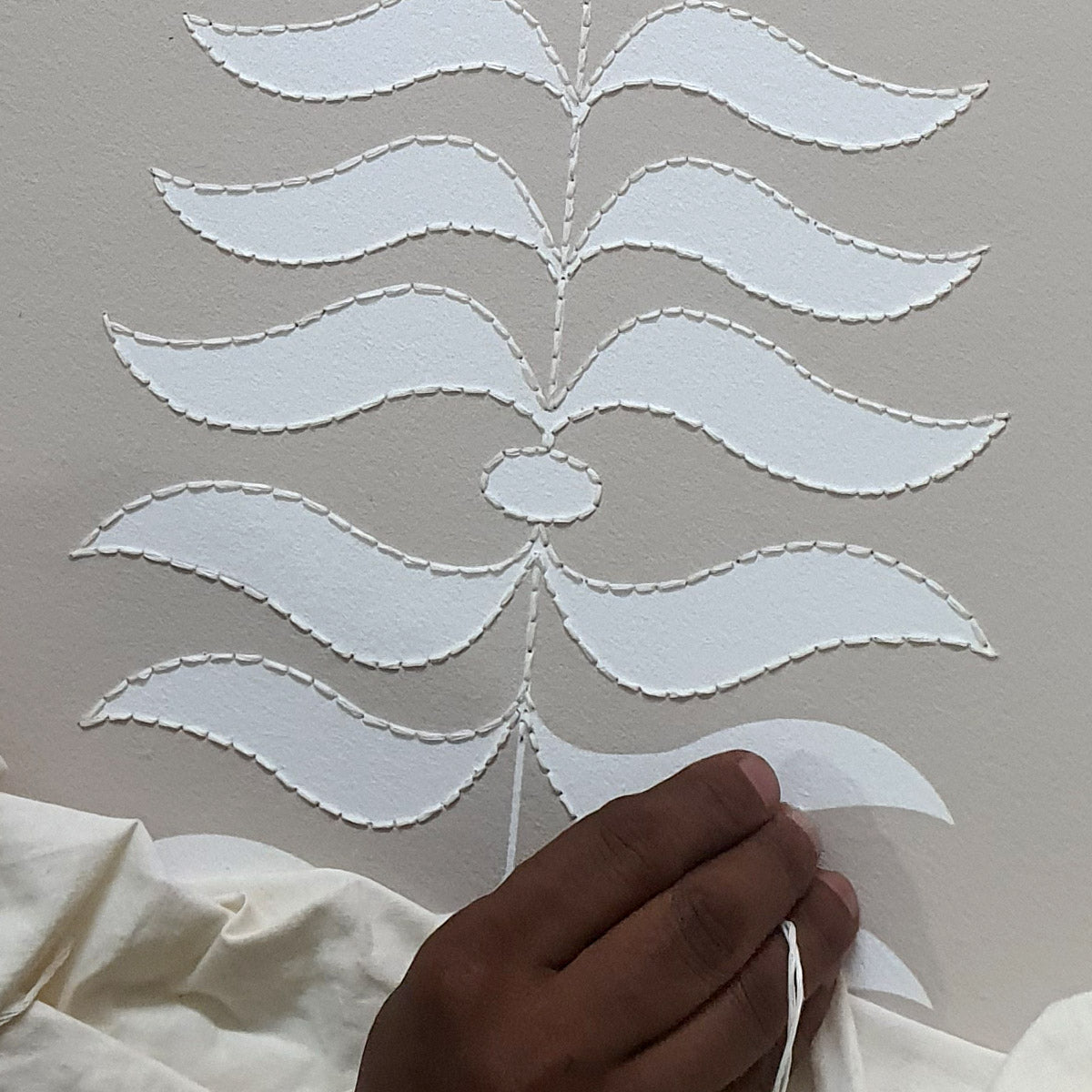
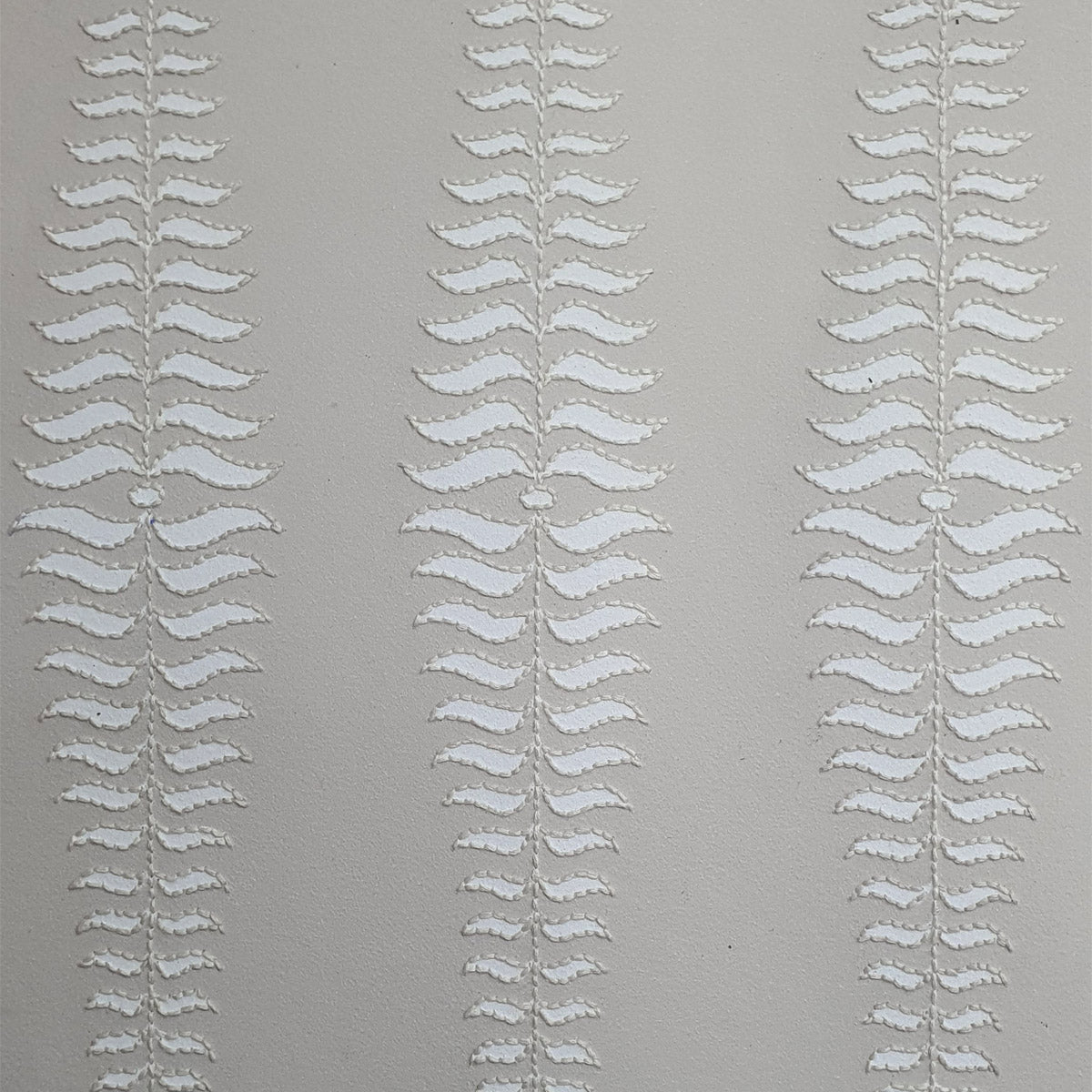
Printed on archival wallpaper and articulated through self-tone kantha stitch, the embroidery adds relief without contrast.
The objective was structural presence, not decoration.
Spatial Behaviour & Resonance
The surface behaves as vertical stabilisation.
Across the shutters, the embroidered fern acts as a quiet axis — grounding the cabinetry while maintaining atmospheric restraint.
From a distance, the installation reads as composed and uninterrupted. At proximity, the hand stitch reveals tactile modulation through subtle shadow and thread elevation.
The dual reading allows the surface to integrate architecturally while still carrying craft intelligence.
In a private, intergenerational bedroom setting, the intervention introduces depth without visual noise.
To see how this surface operates in architectural joinery, view the Case Study: Fern as Vertical Canopy — Wardrobe Surface System.
Process & Material Calibration
The project began as a small-format sample study.
Initial prototypes explored:
• Motif proportion
• Kantha stitch density
• Archival paper stability
• Thread tension behaviour
Scaling from prototype to full shutter height required recalibration of stitch rhythm to ensure continuity across panels.
Each fern outline was individually hand-embroidered using kantha stitch in matching tone thread. The decision to maintain tonal unity ensured that the surface remained atmospheric rather than illustrative.
Here, craft operates as structural reinforcement.
Current Manifestation
Installed across custom wardrobe shutters in a New Delhi residence.
Collaboration: Anagram Architects (AD50)
Surface: Printed archival wallpaper with hand-executed kantha embroidery
Application: Vertical shutter planes
Motif Logic: Bi-directional fern axis
Expansion & Commissioning Potential
This surface logic may extend into:
• Full-height architectural wall panels
• Integrated shutter systems
• Textile-paper hybrid installations
• Hospitality suites seeking restrained tactile articulation
Commissioning allows modulation of scale, stitch density, and vertical continuity while preserving the study’s architectural discipline.
To understand how such systems evolve, explore Surface Systems.
For bespoke adaptations, see Working Together.
Surface Study Details
Medium: Printed archival wallpaper with hand-executed kantha embroidery
Substrate: Archival paper base
Scale: Prototype study scaled to full-height shutter installation
Architectural Potential: Wardrobe shutters, wall panels, integrated cabinetry, embroidered wallpaper systems
Choisir les options
Commissioned Adaptations
While initially developed at an intimate scale, each surface study holds potential for architectural recalibration. Density, motif structure, and material articulation can be restructured in response to wall dimensions, spatial rhythm, and site context. Commissioned adaptations evolve through the studio’s structured development framework.