Article: Architectural Veneer Systems in Contemporary Interiors
Architectural Veneer Systems in Contemporary Interiors
For centuries, veneer has been used to introduce refinement into architecture.
Thin slices of timber allowed rare species to be distributed across furniture, cabinetry and interior surfaces without requiring massive structural sections of wood. Veneer made it possible to combine craft precision with architectural scale.
Yet within most contemporary interiors, veneer remains largely confined to predictable expressions, wardrobes, wall panels or cabinetry finished in polished timber.
The material behaves beautifully, but its architectural potential often remains underexplored.
Increasingly, designers are reconsidering veneer not simply as a finish but as a surface system, a material capable of carrying texture, depth, and narrative across architectural planes.
For a deeper technical understanding of how embroidery integrates into wood surfaces, refer to our technical guide to embroidered veneer panels.
Veneer as Surface Architecture
When veneer is treated as a surface system rather than a finishing layer, its role changes fundamentally.
Instead of serving as a uniform skin applied to cabinetry or panels, veneer becomes a substrate that supports additional layers of material intelligence.
Relief, stitch, carving or inlay can begin to operate within the veneer itself, transforming the surface into an architectural field.
This shift moves veneer from decoration to integration.
The surface no longer merely covers structure — it becomes part of the spatial composition.
Texture and Tactility in Contemporary Interiors
Across contemporary interiors, a clear movement toward tactile surfaces is visible.
Designers are increasingly introducing materials that invite proximity rather than simply creating visual spectacle.
Textured plaster walls, sculpted stone, handwoven textiles and layered surfaces all signal a broader shift toward interiors that reward slow observation.
Within this context, veneer presents an interesting opportunity.
Its stability, scalability and compatibility with architectural joinery allow it to host interventions that introduce tactile complexity without disrupting the integrity of the interior envelope.
This opens the possibility for veneer to move beyond polished timber finishes toward surfaces that carry material depth.
Contemporary interiors are moving beyond flat finishes toward dimensional surface systems that reveal depth through proximity, a shift explored in why flat surfaces no longer define luxury interiors.
Embroidered Veneer as a Surface Innovation
One such exploration is the integration of embroidery into veneer surfaces.
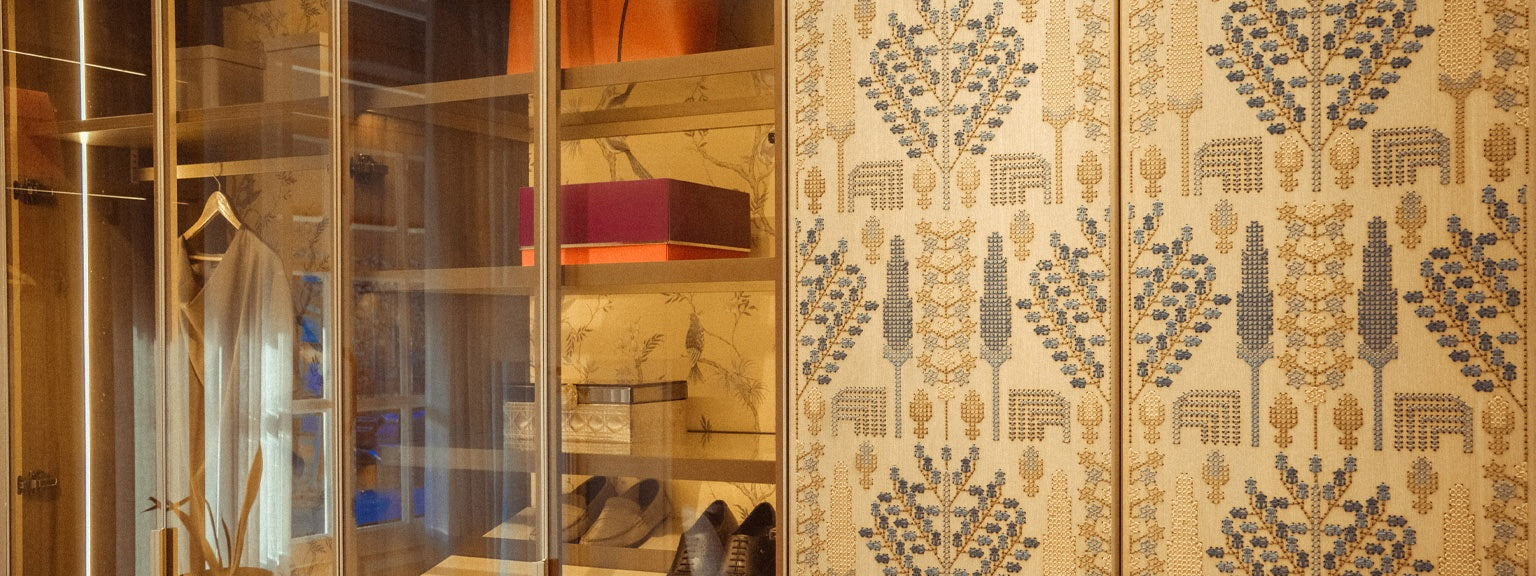
By allowing thread to enter the veneer substrate, embroidery can introduce relief, rhythm and surface articulation while maintaining the underlying architectural structure of the panel.
Unlike textile embroidery, which operates as a separate layer, embroidered veneer integrates craft directly into the timber surface.
The result is a hybrid material where timber grain and stitch interact, producing a surface that behaves differently under light and proximity.
At a distance, the panel reads as composed and architectural.
At proximity, the embroidery reveals material intricacy.
This dual reading allows the surface to operate within contemporary interiors without appearing decorative.
Explore the full possibilities of this material in our embroidered veneer surface
Architectural Applications
When developed as a system, embroidered veneer surfaces can be integrated across a range of architectural contexts:
• wardrobe shutters
• wall panels
• cabinet fronts
• headboards
• hospitality feature walls
• lift interiors
Because veneer panels already form part of architectural joinery systems, the embroidered surface can integrate seamlessly into the language of interior architecture.
The intervention, therefore, remains material rather than ornamental.
One of Gulzoe’s earliest explorations of this idea appears in the study Carpet as Architecture, where Persian carpet grammar is translated into embroidered veneer wardrobe shutters.
Toward Material Intelligence
The growing interest in tactile surfaces reflects a broader shift in how contemporary interiors are conceived.
Rather than relying solely on colour or form, designers are increasingly shaping spaces through material intelligence, the careful orchestration of surfaces, textures and subtle relief.
Veneer, when approached as a surface system, participates naturally in this evolution.
Its adaptability allows it to support new craft interventions while remaining grounded in architectural logic.
Within such explorations, the goal is not novelty but integration, allowing craft to operate quietly within the structural surfaces that define interior space.
Gulzoe approaches these materials as part of broader architectural surface systems rather than isolated decorative panels.
Closing
As interior architecture continues to move toward tactile and material-driven environments, veneer offers a compelling platform for experimentation.
When expanded beyond traditional finishing techniques, it becomes a medium through which craft, structure and surface can intersect.
For studios exploring contemporary material systems, the challenge is no longer how to finish surfaces, but how to allow them to carry meaning.