

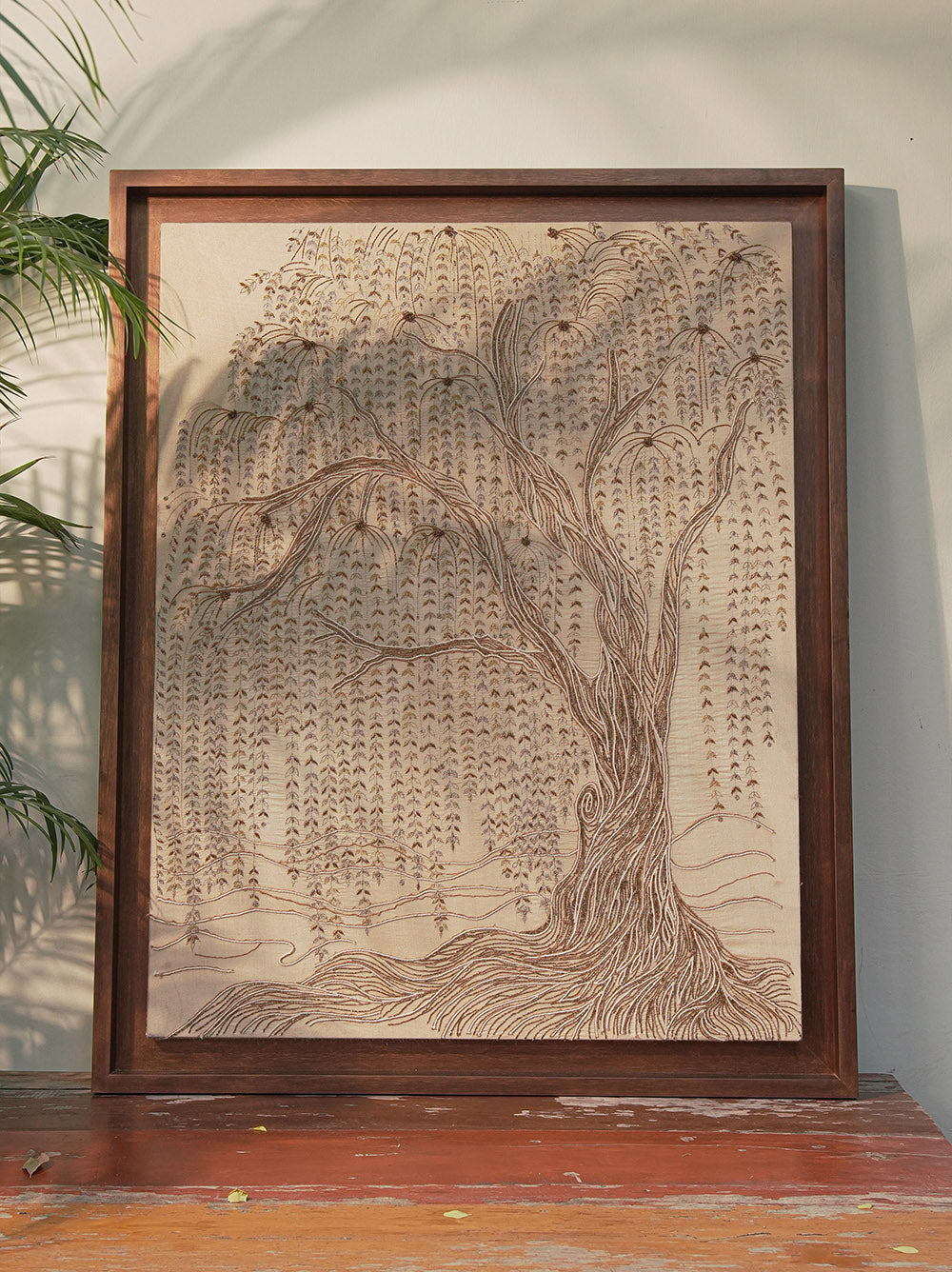
Canopy Without Ornament
Study Intent
This study examines the willow not as imagery, but as structural canopy — an investigation into continuity, fall, and suspended weight.
Rather than relying on contrast, the surface explores how self-toned materials may carry complexity through density, directional movement, and tactile interruption. Metallic zari and dabka articulation are introduced with restraint, functioning as subtle structural emphasis rather than decorative highlight.
The central inquiry addresses how intricacy may be held within discipline, particularly within the expressive nature of hand-woven Tassar silk.
The objective is to allow narrative depth to emerge through material logic rather than visual assertion.
Spatial Behaviour & Resonance
The surface behaves with softness and gravity.
It draws the viewer inward rather than projecting outward. Complexity reveals itself through proximity — through shadow shifts, thread density, and quiet metallic interruption.
The study belongs in interiors where silence is intentional — libraries, private lounges, contemplative bedrooms, transitional corridors.
It resonates with sensibilities that value material honesty, cultural continuity, and surfaces that unfold gradually rather than perform immediately.
Presence here is suspended, not declared.
Process & Material Calibration
The study was first resolved as a framed textile surface to test edge containment, downward fall, and internal rhythm.
Hand-woven Tassar silk was selected for its natural irregularity and depth of tone. Embroidery using metallic zari and dabka was layered with controlled density to maintain structural clarity without disrupting textile movement.
Careful calibration ensured that metallic articulation remained embedded rather than dominant — reinforcing canopy logic rather than fragmenting it.
Surface development and hand embellishment required approximately 260 hours.
Here, craft operates as a gravitational discipline.
Current Manifestation
Initially developed as a framed textile surface study.
Dimensions: H 106 cm × W 86 cm
Substrate: Hand-woven Tassar silk
Medium: Hand embroidery with metallic zari and dabka articulation
This investigation has informed smaller-scale textile fragments within the SAVA Collection.
Expansion & Commissioning Potential
This surface logic may extend into:
• Larger textile wall fields
• Wall-mounted architectural panels
• Integrated upholstered systems
• Framed textile compositions
• Commissioned canopy-led surface systems
Commissioning allows modulation of canopy density, material restraint, scale, and downward rhythm — translating the study from intimate format to architectural plane while preserving structural continuity.
To understand how such textile systems integrate spatially, explore Surface Systems.
For bespoke adaptations, visit Working Together.
Surface Study Details
Medium: Hand embroidery with metallic zari and dabka articulation
Substrate: Hand-woven Tassar silk
Scale: Framed wall art study (expandable to architectural panel format)
Size: H 106 cm × W 86 cm
Hours of Devotion: ~260 hours
Architectural Potential: Wall panels, framed textile compositions, commissioned surface systems
Choose options
Commissioned Adaptations
While initially developed at an intimate scale, each surface study holds potential for architectural recalibration. Density, motif structure, and material articulation can be restructured in response to wall dimensions, spatial rhythm, and site context. Commissioned adaptations evolve through the studio’s structured development framework.